OUTDOOR LIFE
Indoor Cats Live Longer. They Don't Always Live Better.
HARNESS TRAINING, OUTDOOR TIME, AND THE PART OF CAT HEALTH NOBODY SCHEDULES
Lily Aleksand
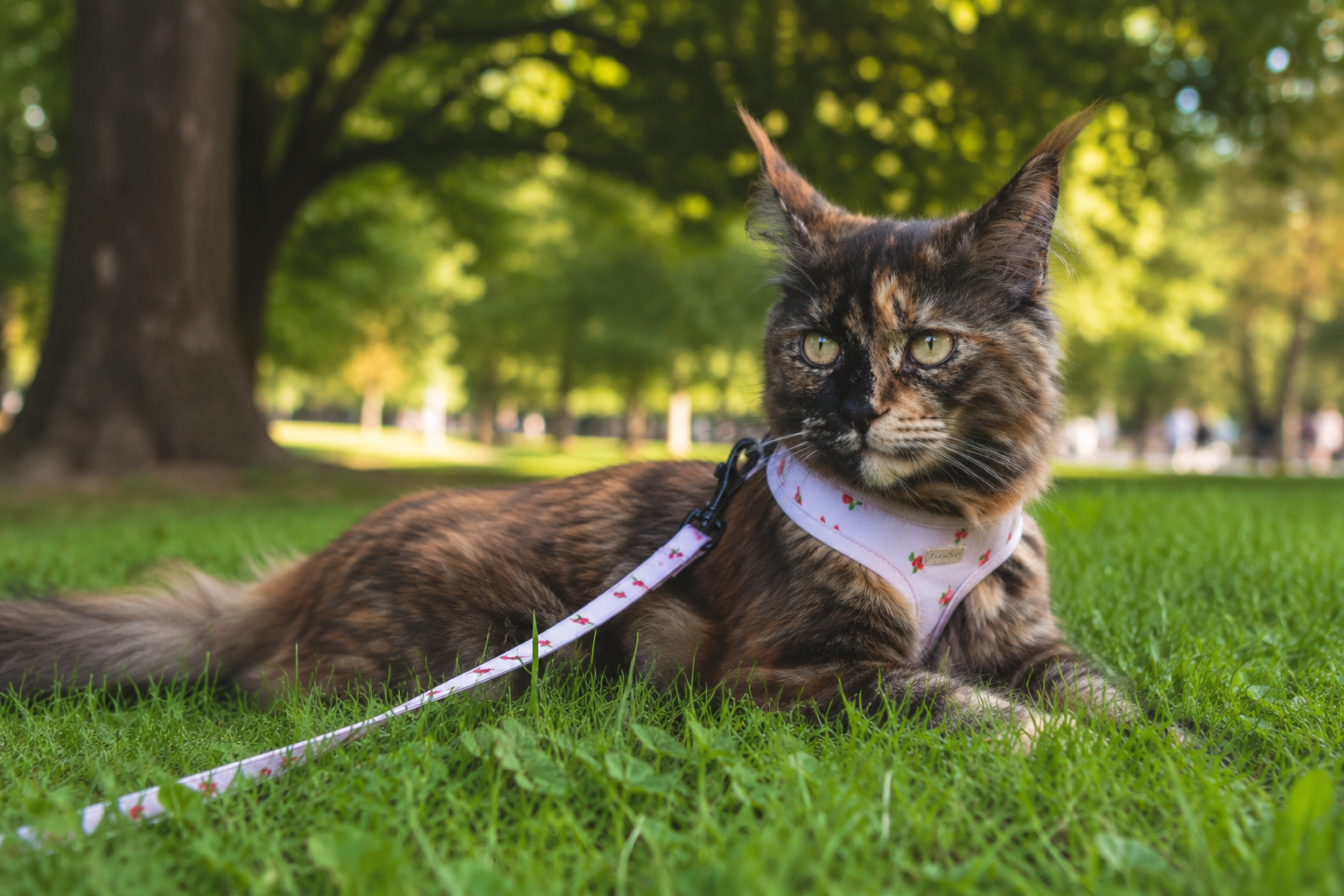
The first time Chagall stood on grass she did not move for ninety seconds. She was four months old and had crossed an ocean from Romania, and she had opinions about most things, but the grass stopped her completely. One enormous polydactyl paw came up and hovered. Down again. Up. She was checking whether the floor was going to hold.
It held. By the third minute she was flat on her belly in it, chin down, watching a sparrow the way a cat watches something she intends to think about later.
I have been doing this with cats for twenty-eight years, on four continents, mostly with strays who arrived with no manners and no history. It works. And still, almost nobody does it.
Here is the strange part. At seven in the morning a woman puts on her coat because the dog needs to go out. Nobody argues with this. She comes home in the evening, hangs the coat by the door, and steps over a cat who has not been outside in six years. That does not register as anything at all.
We decided somewhere along the way that dogs need the world and cats need a window.
THE PART OF CAT HEALTH NOBODY SCHEDULES
We have become good at the measurable parts. We read the ingredient panel. We count her water intake, we book the dental, we weigh her twice a year. All of that is real and all of it matters.
Outdoor time sits in the same category as food and water, and almost nobody treats it that way.
An indoor cat probably lives longer. No cars, no coyotes, no fights, no infection picked up behind a garage. I am not going to argue with the numbers. But longevity and quality of life are two different measurements, and we have quietly agreed to only take one of them.
Think about what happens to a kitten. At four months she is electric. She investigates the inside of a paper bag as though it might contain a secret. At two years she is calm. At five she is furniture. Everyone smiles and calls it maturity. Some of it is. But some of it is a curious animal in a room where nothing has changed since Tuesday, where the smells, the sounds, the temperature and the four available floor textures have all been completely solved.
Indoors she has hardwood, tile, carpet and sofa. Four surfaces, none of them alive. Grass gives under her and springs back and holds the cold from last night. Soil smells like every animal that has crossed it since morning. In one afternoon she gains more texture than her apartment has offered her all year.
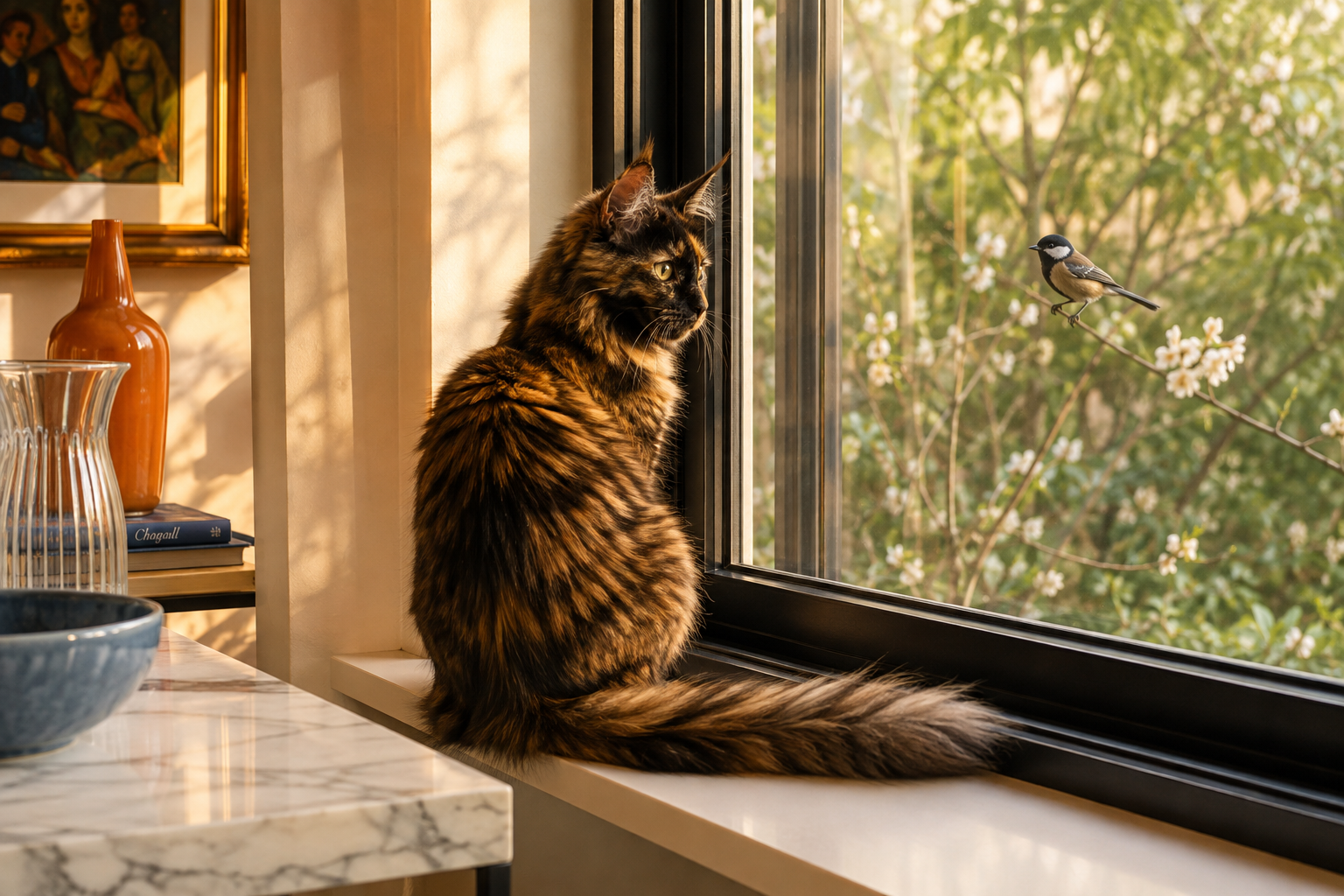
And the birds. She sits at the glass making that stuttering noise in her throat, the one everybody films and finds hilarious. It is a complete hunting sequence with the ending cut off. Outside on a long line she gets to run the rest of it. She drops low. She freezes. Three steps, stop. She catches nothing, which is fine, because the catching was never the point. She comes home and sleeps like a cat who worked, and that sleep looks different from the other kind.
Cats who get outside regularly keep something. I have seen it in every one of them. The curiosity stays switched on. The character does not flatten. She is eleven and still arrives to inspect a grocery bag.
And then there is my favourite part, which nobody warns you about. After a month of this, she watches the window differently. Before, the window was television. After, it is a place. She knows what that tree smells like at the base. She has heard that bird from underneath it. She sits at the glass now with a focused, faintly impatient quality, and what she is doing is not daydreaming. She is waiting to go back.
WHY A HARNESS, AND WHAT A HARNESS IS NOT
A cat carried through a park in a mesh bag is a passenger. She is watching the world go past a screen, at your speed, in the one posture cats hate most: unable to leave. That is transport. It is not experience.
The opposite mistake is worse. A cat let loose on a trail is a cat you may not get back. She goes up a tree, or two hundred metres in a direction you did not see, and the forest is very large.
So there is a middle, and the middle is a harness she genuinely likes with a leash you genuinely hold.
Let me be honest about what that is. A harness is not freedom. A cat on a leash cannot do the thing a cat most wants to do, which is vanish into long grass on her own schedule and come back when she is finished. What a harness offers is the best available compromise between a life with no risk and no world in it, and a world she may not survive. It is not the ideal. It is enormously better than eighteen years inside four rooms.
HOW TO HARNESS TRAIN A CAT
None of this requires preparation. A harness, a leash, and something excellent to eat.
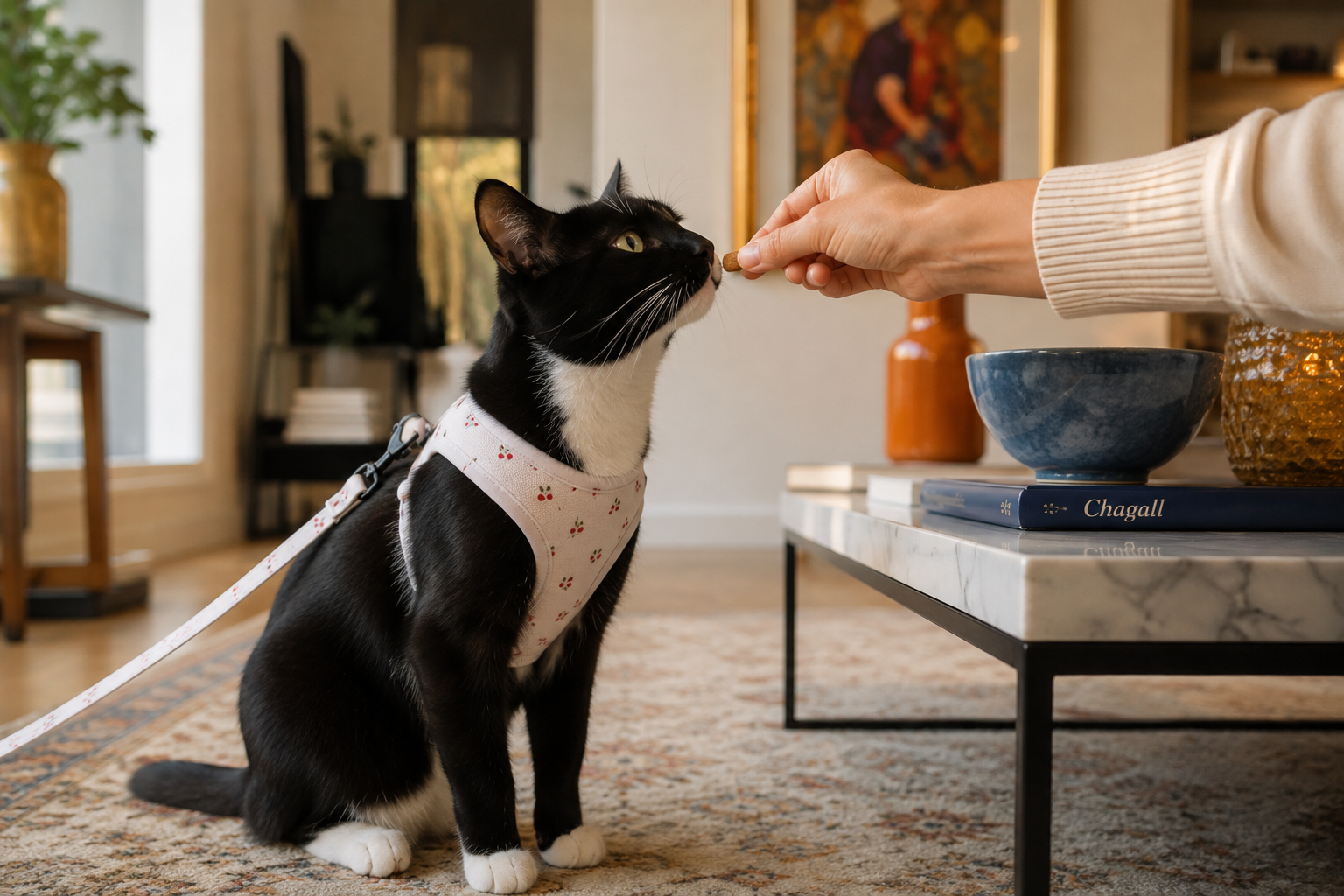
Kittens are easy. Under a year, you have won before you started. Chagall was walking on a leash within three weeks of arriving. Grown cats take longer and get there anyway. The currency is patience and good timing, never force. I have converted deeply skeptical adult rescues by being boring about it for a month.
I put the harness on indoors with no leash attached, for two minutes, with the treat, and I take it off before she asks me to. I do that for a week or two. The first few times she falls over sideways and lies there like a fainting goat. Every cat does this. It passes. Chagall spent her first session pressed flat against the hallway radiator, offended, and her second one forgetting the harness entirely because a moth came in.
I carry her to the park in a carrier and open it there. I do not walk her out through the lobby and across a parking lot, because that is the worst part of the trip and it should not be her introduction to any of it.
I let her set the pace, which is slower than mine. She may sit under a bench for ten minutes smelling the air and then want to go home. That is a successful outing. Cats are not walked. Cats are accompanied.
Twice a week is plenty. Three is lovely. This is not a dog, and you are not committed to seven in the morning in February.
WHERE TO WALK HER
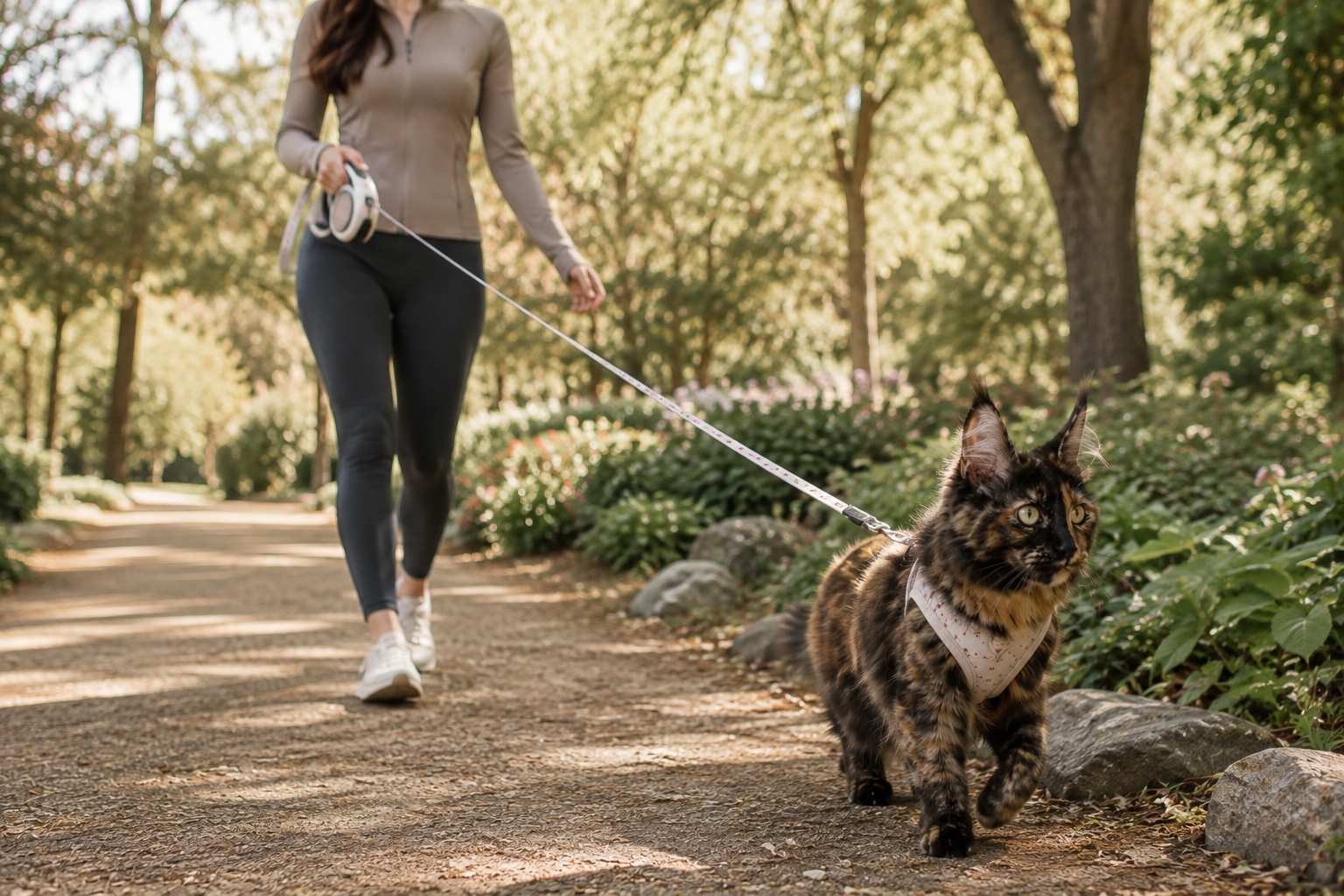
Once we are somewhere open, with no cars, no bikes, nothing moving, I let out the long line. This is the part most people never try. A regular leash keeps her inside a circle about a metre wide, which is fine for a sidewalk and useless in a field. At ten or fifteen metres she can actually pick a direction and commit to it. She flattens out after a butterfly. She runs at a bird and misses. She doubles back to a smell she passed thirty seconds ago and sits down with it, in no hurry at all.
I still have the end of the line in my hand the entire time, and she does not feel fettered by it at all, which is the whole trick. I keep the slack gathered in my palm and let it out as she moves, rather than dropping the length on the ground. A long line left loose finds a tree trunk in under a minute, and then the freedom turns into a knot. Held properly, it disappears. She is running an entire field. I am still, always, the other end of it.
People ask me about spraying, and it is a fair question with a simpler answer than they expect. Most cities post notice when they treat a public space. The signs go up before and stay up after. You are not guessing. You are reading the entrance for four seconds on your way in. Beyond that I go where the maintenance is lightest. The sports fields and the formal flower beds get the attention. The plain stretches of grass do not.
Mostly I use neighbourhood trails. Groomed, local, familiar, the kind of path where you pass someone with a stroller. Not deep woods. Never a busy street, because traffic, loose dogs and sudden noise will undo six weeks of work in four seconds.
And it does not have to be a park at all. A friend with a backyard is perfect, and often better, because she can return to the same one until she knows it.
Snow, incidentally, is a triumph. Short sessions, dry her paws afterward, and prepare to watch something you will not forget.
THE RULES I NEVER BREAK
I never let the harness sit loose. Two fingers underneath is the limit, and it must be the kind she cannot reverse out of, because the ones she can are the reason people lose cats.
I never take a cat out who is not microchipped and current on vaccines and parasite prevention. Fleas and ticks are manageable now, and your vet can usually sort it out in a single visit, but it is a conversation to have before the first outing and not after.
I never clip the leash to something and step away. Not for a second, not for a photograph. I learned that one in Lisbon, from a bench leg and a pigeon, and the four minutes it took to coax a furious cat out from under a parked car.
I wipe her paws when we get home, every time, with a damp cloth. Everything she walks on goes into her mouth within the hour.
And I do not do this to a senior cat who has spent fifteen years indoors and asked for none of it. She has built a world she understands, and dismantling it at sixteen is not a gift. A sunny window, a safe balcony and a screened door are the kinder version for her.
But if you have a kitten, or a young cat, or an adult with a curious streak and a tolerant heart, she is waiting on you.
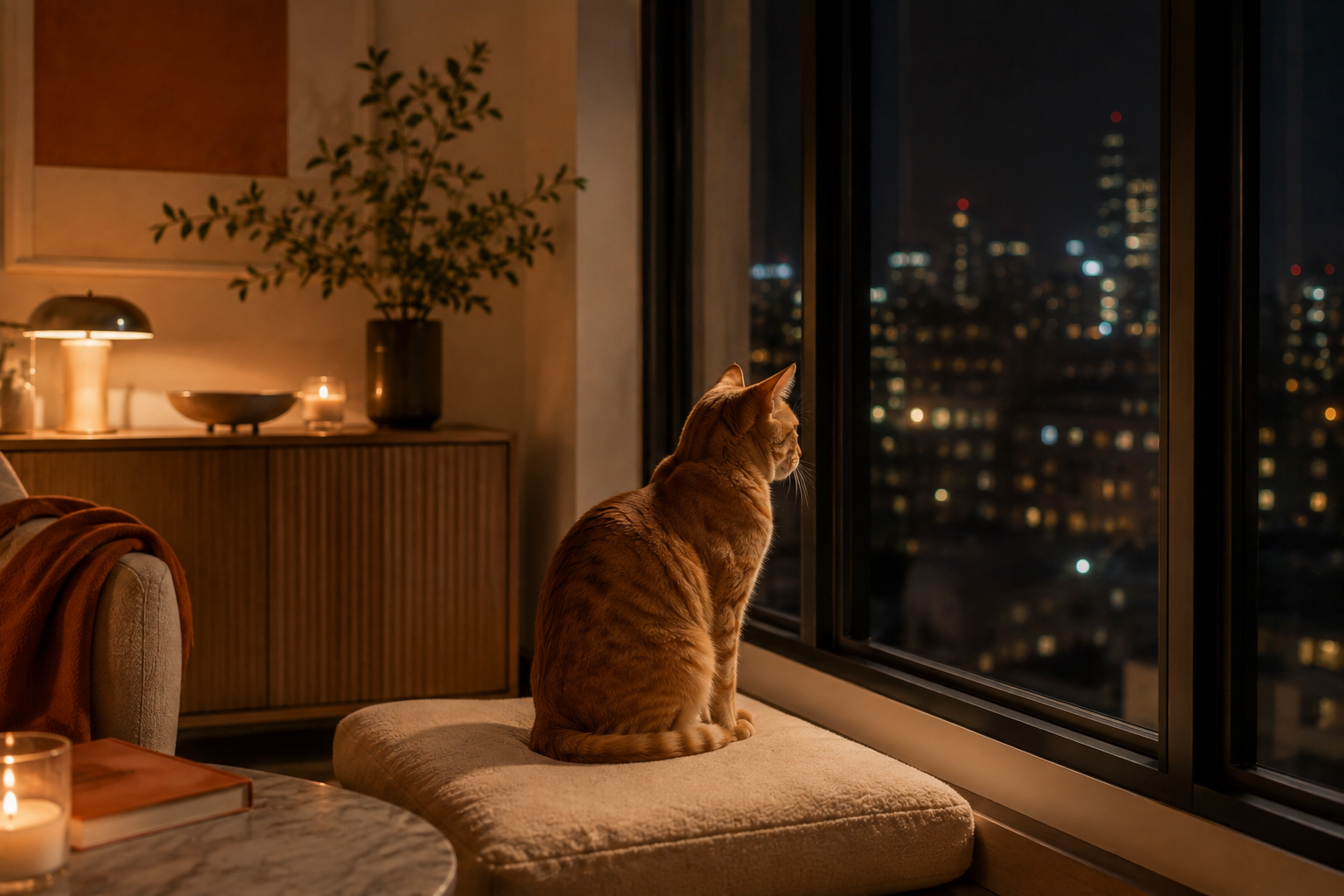
Watch her at the window tomorrow. Watch what she watches, and for how long, and what her tail does while she does it. She has been telling you where she wants to go for years.
Chagall still stops at the edge of the grass and lifts one paw. She does not hold it there for ninety seconds anymore, but she holds it long enough. The floor has held for years. She just likes to be sure.
This is what I learned from cats.
COMPLIMENTARY GUIDE
The Thirst That Does Not Speak
Hydration is the quietest longevity practice in the house. Leave your name and email and I will send the guide to you.